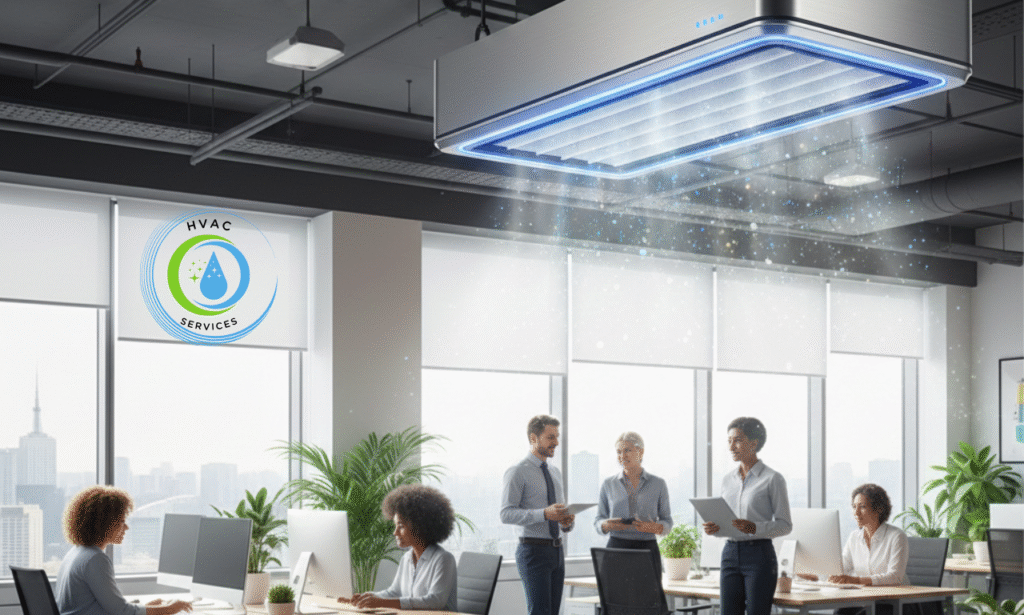
Clean indoor air is essential for every commercial building, whether it is an office, school, hospital, retail space, warehouse, or public facility. A reliable commercial air filtration system helps remove dust, allergens, odors, airborne particles, and pollutants before they affect employees, customers, visitors, or equipment.
For business owners, facility managers, and property managers, commercial air filtration is not only about comfort. It also supports healthier indoor air quality, better HVAC performance, improved energy efficiency, and a more productive business environment.
Why Commercial Buildings Need Better Air Filtration
Commercial buildings usually have more people, more foot traffic, more dust, and longer HVAC operating hours than residential spaces. Without proper air filtration, pollutants can circulate through the building and affect comfort, health, odor control, and overall air freshness.
Office and commercial building air filtration is especially important in spaces where employees, customers, students, patients, or visitors spend several hours indoors. Better filtration can help reduce airborne particles, improve comfort, support cleaner indoor environments, and make the HVAC system work more efficiently.
Air Quality Matters in Commercial and Public Buildings
Commercial Air Filtration spaces experience high foot traffic, which brings dust, bacteria, viruses, and volatile organic compounds (VOCs). Poor air quality can lead to health complaints, increased absenteeism, and lower performance. This makes investing in reliable air filtration a necessity rather than an option.
What Is Commercial Air Filtration?
Commercial air filtration is the process of removing dust, pollen, allergens, smoke, odors, VOCs, bacteria, and other airborne particles from indoor air in commercial buildings. These systems are commonly connected to commercial HVAC systems or used as standalone air purification units in offices, schools, hospitals, retail stores, restaurants, warehouses, and public buildings.
Unlike small residential filters, commercial air filtration systems are designed to handle larger air volumes, higher occupancy levels, and continuous operation. A good system improves indoor air quality while also helping protect HVAC equipment from dirt buildup and restricted airflow.
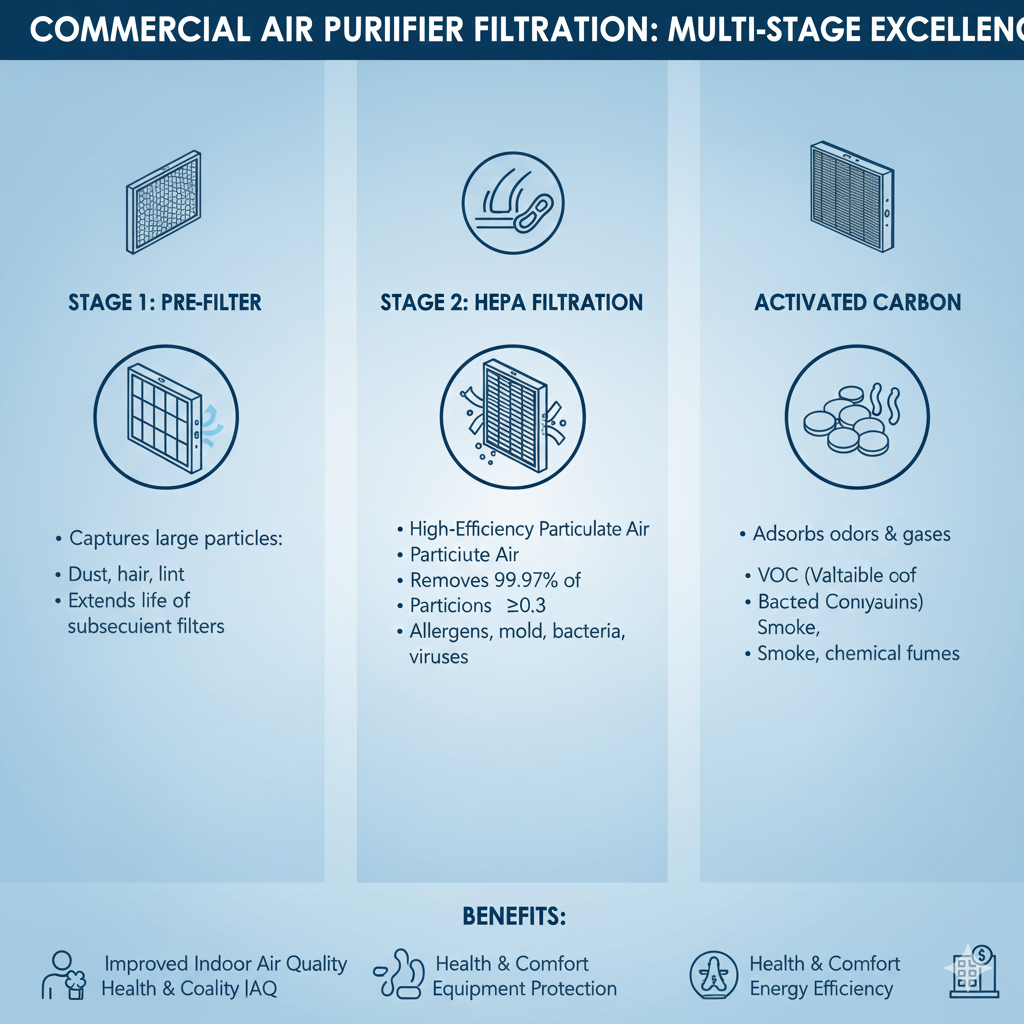
Understanding Air Filters: Basics and Beyond
Air filters work by trapping airborne particles as air passes through them. The effectiveness depends on the filter’s material, density, and design. Commercial buildings require filters with higher efficiency because of the volume of pollutants produced.
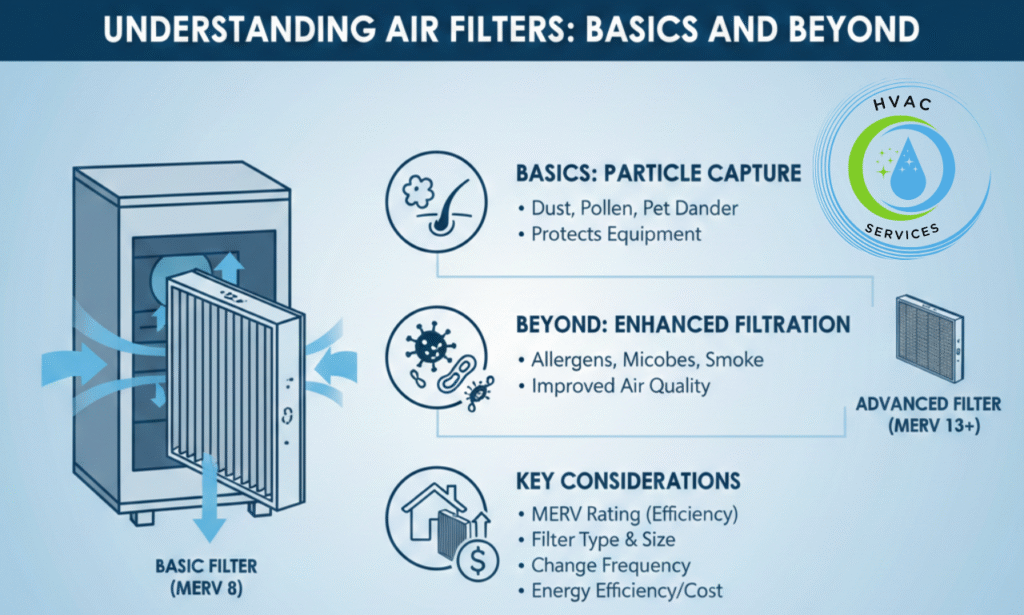
Types of Commercial Air Filtration Systems
The best commercial air filtration solution depends on the building type and indoor air quality problem. Common options include MERV-rated HVAC filters, HEPA filters, activated carbon filters, electrostatic filters, and UV-C air purification.
MERV-rated HVAC filters are commonly used inside commercial HVAC systems to capture dust, pollen, and airborne particles. HEPA filters are useful for sensitive spaces such as hospitals, clinics, labs, and high-traffic buildings. Activated carbon filters help reduce odors, smoke, chemical smells, and VOCs. UV-C systems can support commercial building air purification by helping reduce microbial growth inside HVAC components.
-
HEPA Filters – Capture 99.97% of particles as small as 0.3 microns.
-
Medical-Grade Filters – Designed for hospitals, labs, and healthcare facilities.
-
Activated Carbon Filters – Remove odors, chemicals, and VOCs.
-
Electrostatic Filters – Charge particles to improve capture efficiency.
-
UV-C Light Filters – Destroy airborne pathogens like bacteria and viruses.
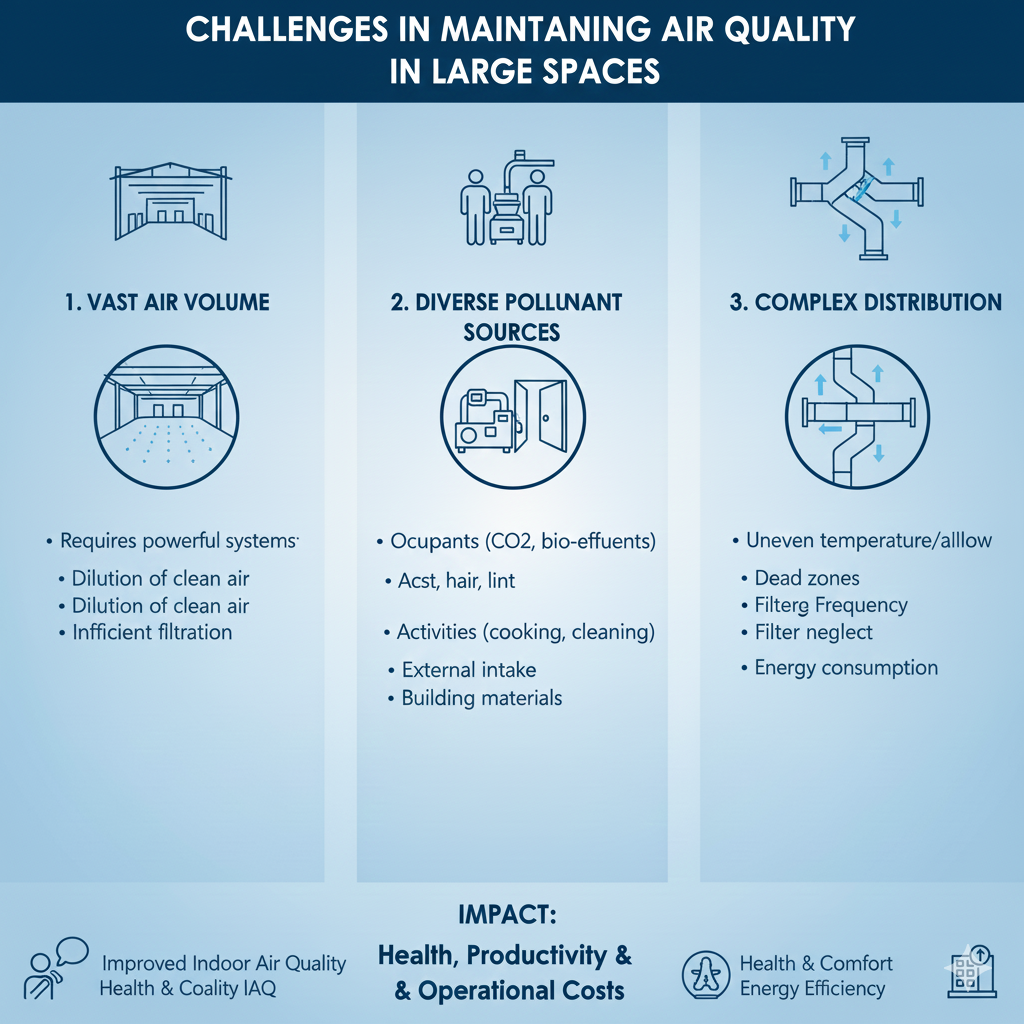
Challenges in Maintaining Air Quality in Large Spaces
Large buildings face unique challenges such as high occupancy, shared ventilation systems, and larger amounts of pollutants. Dust accumulation, humidity variations, and inadequate ventilation contribute to declining air quality. Maintaining proper filtration is essential to keep indoor environments healthy.
How to Choose the Best Commercial Air Filtration System
To choose the best commercial air filtration system, start with building size, occupancy level, HVAC capacity, indoor air quality concerns, and maintenance needs. A small office may only need upgraded HVAC filters and portable air purifiers in high-use rooms, while a large commercial building may require advanced filtration and a professional commercial HVAC air purification system.
Before installing higher-efficiency filters, check whether your HVAC system can support them. Filters with too much airflow resistance can reduce system performance and increase energy use. For best results, a licensed HVAC professional should recommend the right MERV rating, filter type, and maintenance schedule.
Medical-Grade Filtration
Medical-grade filters go beyond standard HEPA systems and are capable of capturing microbes, viruses, and ultrafine particles. These are essential for hospitals, clinics, labs, and even schools.
Reliable and Long-Lasting
Commercial air purifiers must handle constant operation. Long-lasting filters reduce maintenance frequency and ensure consistent air quality.
Air Quality Sensing
Modern purifiers come with smart sensors that detect pollutants, monitor air quality in real-time, and adjust filtration speed automatically.
Easy-to-Use Designs
User-friendly controls, simple filter replacement mechanisms, and automated modes help building managers maintain system efficiency.
Portability
Portable Commercial Air Filtration purifiers allow flexibility. They’re ideal for classrooms, conference rooms, and other areas that need targeted air purification.
Size Considerations
Choosing the right size ensures the purifier can handle the room’s air volume. Undersized units reduce filtration efficiency.
Noise Levels
Commercial Air Filtration buildings, especially schools and offices, require quiet operation. Low-noise purifiers help maintain comfort without disturbing activities.
Best Air Filters for Commercial Buildings
The best air filters for commercial buildings are the ones that balance filtration efficiency, airflow, maintenance cost, and HVAC compatibility. For many offices and commercial spaces, MERV-rated filters are a practical option because they capture common airborne particles while allowing the HVAC system to operate efficiently.
For stronger air quality needs, HEPA filters and activated carbon filters may be added. HEPA filters help capture fine particles, while activated carbon filters help control odors and chemical pollutants. Businesses should avoid choosing filters based only on price because low-quality filters may clog quickly, reduce airflow, and fail to solve indoor air quality problems.
-
Hospitals require medical-grade HEPA filters.
-
Offices benefit from HEPA + activated carbon for allergens and odors.
-
Schools need quiet systems with portable options.
Evaluating these needs ensures the best indoor air quality throughout the building.
Commercial HVAC Air Purification and Air Treatment Options
Commercial HVAC air purification works best when it is matched with the building’s air quality needs. Offices, schools, hospitals, retail spaces, and public buildings may need different levels of filtration depending on occupancy, ventilation, odor problems, and dust levels.
Commercial air treatment may include HVAC filters, HEPA filtration, activated carbon, UV-C purification, and air quality sensors. These options can work together to support cleaner indoor air, reduce odors, and improve comfort in office and commercial building air filtration setups.
-
HEPA + carbon filtration
-
High CADR (Clean Air Delivery Rate)
-
Smart air quality sensors
-
Quiet modes
-
Energy-efficient operation
These models are designed to deliver consistent performance across large areas while minimizing operational costs.
Innovations and Trends in Air Filtration
The industry continues evolving with new technologies:
-
AI-powered airflow management
-
IoT-enabled monitoring
-
Advanced pathogen-removal systems
-
Improved, eco-friendly filter materials
-
UV-C and plasma air sterilization
These innovations help commercial buildings stay ahead of rising air quality demands.
Practical Application
Implementation and Maintenance
Commercial air filtration systems need regular maintenance to perform well. Filters should be checked and replaced on schedule, HVAC coils should be cleaned, and airflow should be inspected to make sure the system is not restricted.
Facility managers should pay special attention to high-occupancy areas such as conference rooms, classrooms, waiting rooms, clinics, and shared workspaces. Regular inspections help keep the system efficient and prevent air quality problems from becoming more expensive.
For effective long-term indoor air quality improvement:
-
Conduct regular filter replacements
-
Install purifiers in high-traffic and poorly ventilated areas
-
Use sensors for real-time air quality monitoring
-
Combine air filtration with proper ventilation
-
Schedule professional HVAC inspections
Consistency is essential to ensure optimal filtration performance.
Success Stories in Air Filtration
Many schools, offices, and hospitals have reported:
-
Fewer sick days
-
comfortEnhanced
-
Better odor control
-
Higher employee productivity
-
Improved health outcomes
These results highlight how proper air purification directly contributes to healthier and more productive environments.
FAQs About Commercial Air Filtration
What is commercial air filtration?
Commercial air filtration removes dust, allergens, odors, pollutants, and airborne particles from indoor air in offices, schools, hospitals, retail stores, and other commercial buildings.
What are the best commercial air filtration systems?
The best commercial air filtration systems usually include MERV-rated HVAC filters, HEPA filtration for sensitive areas, activated carbon for odors, and regular HVAC maintenance.
Do commercial buildings need air purification?
Yes, many commercial buildings need air purification because high occupancy, shared ventilation, dust, odors, and pollutants can affect indoor air quality and comfort.
What is commercial HVAC air purification?
Commercial HVAC air purification uses filters and air treatment technologies inside or alongside HVAC systems to improve indoor air quality in commercial buildings.
What are the best air filters for commercial buildings?
The best air filters for commercial buildings depend on HVAC compatibility and air quality needs. Many buildings use MERV-rated filters, while sensitive spaces may need HEPA filtration.
How often should commercial HVAC filters be changed?
Commercial HVAC filters should be checked regularly and replaced based on usage, dust level, occupancy, and manufacturer recommendations. High-traffic buildings may need more frequent changes.
Can commercial air filtration reduce odors?
Yes, activated carbon filters can help reduce odors, smoke, chemical smells, and VOCs in offices, restaurants, retail spaces, and other commercial environments.
Conclusion
Clean indoor air is important for every office, school, hospital, retail space, and commercial building. With the right commercial air filtration systems, proper HVAC maintenance, and suitable air purification options, business owners and facility managers can create healthier, cleaner, and more comfortable indoor environments.
If your building has dust, odors, poor airflow, or indoor air quality issues, a professional HVAC inspection can help you choose the right commercial air filtration solution for your space.
If you are looking for the best commercial air filtration systems for buildings, our team can help you choose and install the right solution for cleaner, healthier indoor air.